Tuesday, August 13, 2013

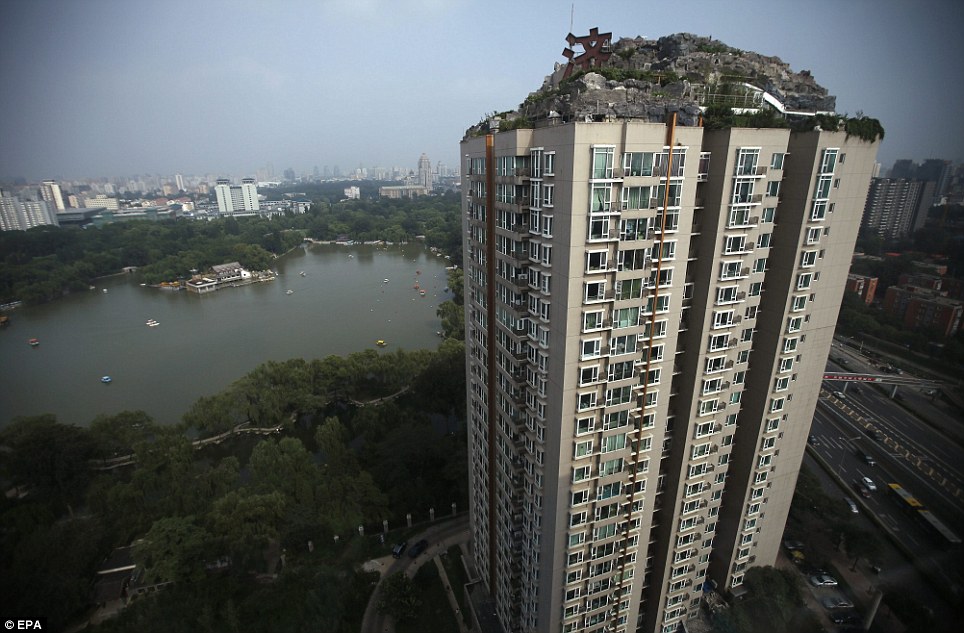
Moving Mountains, in Beijing

Fancy a getaway to a mountain villa for some peace and quiet but too busy or lazy to travel out of town? Well, a certain eccentric professor in Beijing took it upon himself to upend the old saying that “Muhammad must go to the mountain” if the mountain won’t come to him. Indeed, Professor Zhang Lin has shown that all adages have their exceptions. The problem is that he aimed to prove his point without employing a shred of common sense, by assembling his mountain stone by stone atop his high rise penthouse apartment. To boot, he did not bother receiving any government permits or soliciting consent from his neighbors to undertake the renovations. Perhaps more alarmingly, he installed large steel struts on the outside of the building to support the monstosity, lest the weight of the pile of rock and rubble collapses the entire structure.
 
A government official has already indicated that the building's supplement will need to be reversed. In the meantime, the serenity of his urban/alpine home has (not surprisingly) been disrupted by the noisy ire of his fellow residents. And it’s hard to imagine that the nutty professor can accuse them of making a mountain out of a molehill - he’s already beaten them to it. Let’s just hope that, once the mountain is returned to where it belongs, he uses the travel time to visit it wisely - for quiet contemplation and reflection on social responsibility.
 

Saturday, August 10, 2013

Sometimes, Wealth is Only Money.

Can’t buy me taste.

The following essay was posted on Facebook yesterday by a former colleague. It’s an interesting on-the-ground report from Nanjing on the wealth disparity and social decorum schizophrenia epidemic on the Mainland these days. Thanks, Brent.
There is a widening gap between the haves and the have-nots in China....

Sinophiles regale the rich and famous here although few actually spend time on the ground nor have lived here for any extended period of time.

I would caveat the 'class disparity' with more of a 'wealth disparity' instead...

Case in point: I currently live in Nanjing, which is a tier 2 city. Tier's notwithstanding, there are 7 million people here, roughly 12 LV shops, 10 Gucci shops, an equal number of Hermes, Prada, Cartier and other luxury fashion brands....in addition, there is a Bentley dealer, Lamborghini dealer (that has an adjoining door to Subway sandwiches) and of course all the other luxury/exotic car brands.

Sales of all are brisk and since being here for the past three years, the foot traffic and purchases haven't slowed down in the least bit moreover, they've increased.

The first year I was here, I lived in a mid-range apartment high-rise. After constantly arguing with the tenants and management office about people keeping their scooters in the hallway, storing excess items including food disposal in the hallways, leaving trash and cigarette butts in the halls and elevators and walking their dogs in the hall and stairwells and not cleaning it up, I gave in and moved to a luxury high-rise. It is important to note that my building is in the top three most exclusive buildings in Nanjing and I made the move only to (hopefully) leave the barbarian hordes.

The parking garage rivals any in La Jolla, Monaco, Upper East Side of NYC or South Beach with 11 Land Rover Evoques, AMG Mercedes, 7 Series BMW's, several Bentleys and one guy that has matching Ferrari's for him and his girlfriend….Incidentally, there is a PLA General that lives here and has two Mercedes G-Wagons which retail for US$350,000 and a Brabus 500. Reportedly, he made over US$800 million on infrastructure projects (read: stole or kick backed).

However, my elevator lobby still boasts excess storage of junk (literally) with empty baby formula cans, broken chairs, cat litter boxes (uncleaned) and about half the floors have scooters or bikes outside the front doors as well as plastic shoe collections (that's another story entirely).

People walk their dogs in the hallways and front lobby letting them use the floors as their deposit areas. Men (and women too) spit on the floor and also drop fruit peelings and sunflower seeds everywhere.

And my all time favorite, is the babies without diapers - the parents or grandparents teach them to s*** by holding their legs apart over the floor or a wastebasket and whistling. Many times, just leaving it for the cleaning staff to attend to. Or, if I'm lucky, someone will step in it 

This is not an isolated incident. Far from it. Friends of mine in other cities including Beijing and Shanghai also complain about this behavior.

One of my Facebook connections and former colleagues regularly posts items about the AsiaOnePercent and this posting is meant to be in direct contrast to that....

So for those of you outside China looking in and marveling over the 'economic miracle', it's only money.

BishopOne
 

Thursday, August 8, 2013

French Laundry, or Chinese?

Crisp Wines, Cleaned Cash

The two articles below – on a mansion in Cannes thought to be owned by disgraced Chinese politician Bo Xilai, and suspicions of French winery purchases by Chinese for the purpose of laundering money offshore – may or may not be directly related. However, both shed light on the shady practice used by some wealthy Chinese (as well as from other nationalities) of buying international properties through an inscrutable network of intermediate holding companies to mask the true identity of owners.
 
The Bo Xilai story in the Wall Street Journal comes just as his corruption trial in China is finally getting under way. The Cannes villa, a six-bedroom structure with a swimming pool, a 4,000 square meter garden and views of the Mediterranean, is legally owned by a French company that is controlled by two firms based in Luxembourg, whose legal representatives are three local lawyers. Got that? More interesting is that the property was once managed by Neil Heywood, the British businessman who Bo’s wife murdered by poisoning.  One of the reasons he allegedly fell out so comprehensively with her was over disputed fees related to properties managed in international locations, including France.
 
The SCMP article points to a wider trend of Chinese buying French wineries through offshore holding companies, and then re-selling them after a short holding period. The “harvest” is a cellar full of cleaned-up cash that is more broadly liquid in the international banking system. Chinese investors currently own approximately fifty properties in Bordeaux alone, and will soon be the most prevalent nationality of foreign owners in the region, overtaking Belgians. It remains to be seen who the long term owners – i.e. those buying the properties with the aim of actually producing wine - of many of these properties ends up being, once the initial spin cycle of ownership is completed and ulterior motives for purchases come out in the wash.


Wednesday, August 7, 2013

Of Ghost Stores and Luxury To Go

Looking for a pepperoni pizza and a black Epi leather pochette bag to go.

There is a discernible echo inside the nearly empty halls of luxury stores around Hong Kong during these summer months. The sales people look bored - Candy Crush notwithstanding - and don’t appear to be scurrying around as often as they recently did in service to visiting mainland shoppers, gathering up racks of leather goodies or sparkling jewelry.  From these outward appearances, the double whammy of China’s economic slowdown and Xi Jinping’s anti-graft crackdown are definitely taking a bite out of luxury sales in Hong Kong and on the mainland. As further evidence of the slowdown, this article in the Asia Sentinel ponders why Louis Vuitton failed to complete a lease on a sizeable space (at rent of US$2.6 million per month) in Hong Kong’s Time Square. Perhaps LVMH is finally balking at the absurdly high rents being demanded by Hong Kong landlords for prime retail space. Perhaps the Europeans are feeling the pinch of Chinese tastes moving away from logo-emblazed handbags, wallets and luggage towards more discreet offerings.
However, before shedding alligator-skinned tears for the purveyors of luxury goods facing hard times, consider that there may be other consumption trends afoot that are keeping the good times rolling, only more quietly. According to a recent report in the SCMP newspaper, Chinese VIPs have been able to continue to indulge their taste for la dolce vita through telephone orders to shop hotlines, away from the prying eyes of the media. Want that pretty dyed pink ostrich skin Birkin bag?  Simply check out the Hermes website, pick up the phone to the Tsim Sha Tsui shop, and voila, in a few hours, it’s in your hotel room! What could be more convenient? Therefore, though the foot traffic inside the stores is decidedly lighter, it’s a safe bet that the freight elevators inside hotels and office buildings are still seeing an active flow of boxes wrapped with pretty ribbons. With a brisk trade in luxury-to-go, why bother with annoyingly high rents, costly overhead and wagging fingers from the public?

A basic law of physics states that, for every action, there is an equal and opposite reaction. Similarly in China, where there are government measures, there are always available countermeasures. Or in plain English, where there’s a will, there’s a way. That's especially true when the margins are fat and the goods are so easy on the eye.

Sunday, August 4, 2013

London – India’s Summer Palace

Going local
 
Strolling around London’s posh Mayfair district during the summer months, a dim-witted historian might well be confused into recalling that India once colonized England, not the other way around. As discussed in this Economist article, when the sweltering summer heat settles into India, the wealthy Indians resettle to the cooler climes of London. While other districts such as Knightsbridge have become more associated with Russians and Belgravia with Americans and Italians, Mayfair is an enclave that has taken on a decidedly subcontinent feel. This is not a new trend – well-heeled Indians have been buying property in London for over a century – however, the action has picked up significantly in the past few years. According to the article, one in four flats and houses sold in Mayfair these days are to Indians. Estimates are that 3,000 rich Indians now migrate there every summer.
 
With a critical mass of Indian movers and shakers present in the district, occasions for social networking have become more than conveniences – they have become necessary and highly competitive obligations. Attending cocktail parties at The Dorchester or 51 Buckingham Gate (owned by the Tata Group), watching the tennis action at Wimbledon, or taking in the Test cricket match at Lord’s Cricket Ground are must-do’s. Opportunities for glad-handing and one-upmanship abound. Given how Indians love a good bling-dripping party, one imagines that there is precious little time for true relaxation.
 
The article highlights an interesting and unfortunate social consequence - that these elite have begun to take on some of the characteristics of their erstwhile rulers, but now with the wing-tipped shoe on the other foot.  Whereas the British colonials were once accused of shutting themselves off from the local Indian population by holing up in wide-boulevard hill-stations, high class Indians are now accused of maintaining minimal contact with British society (other than through their Eton/Oxbridge/Kings College school networks). This phenomenon has also applied to investments and business deals, whereby few large deals in the past few years have involved Indian buyers. There are undoubtedly several theories – some controversial, others just politically incorrect – why this segregation is occurring. However, one undisputed issue is the confirmation that London is increasingly less characteristic of the UK and more emblematic of a globalized money and consumption flows, led by emerging market cash.

Thursday, July 4, 2013

Going Dark for July


This reporter and his staff are heading away from the blogosphere for a few weeks for some warm weather R&R. Wishing everyone a relaxing time during this break, possibly in the mountains or on a beach away from both the 1% and the 99%.

Wednesday, July 3, 2013

Of Masked Men and Jimmy Choo’s

For a quick getaway, try stealing Nike Air’s next time.

The following SCMP article in this morning’s paper is of a Hong Kong expatriate couple who suffered the indignity of having a collection of eighty ladies’ shoes worth US$51,000 (or $640 each) stolen from under their feet as they were moving apartments. Separately, as reported a day earlier (in a less reputable daily rag), a video store across town reported that their full season set of Sex and The City DVDs was shoplifted. Coincidence or not?  

It was a husband's nightmare come true: left to watch over his wife's HK$400,000 collection of designer shoes, a Belgian businessman dropped his guard for five minutes and returned to find them stolen. It happened in Hollywood Road about midday yesterday while the couple were moving out of their apartment. The 80 pairs of shoes were in two suitcases sitting on the pavement as removal workers loaded other items, including furniture, into their truck. The man left his post briefly and "when he returned five minutes later, the two suitcases had disappeared", a police investigator said. The businessman called police after the workers told him they had not loaded the suitcases into the truck. "Police were told that the shoes were expensive designer products and each pair cost about HK$5,000," the officer said. Officers mounted a fruitless search of the area for the suitcases. In an effort to identify the thief or thieves, police will check footage of surveillance cameras from shops in the vicinity. Detectives from Central police station are investigating. No one has been arrested. Another officer said thieves, believed to be foreigners, were looking for opportunities in Central, Tsim Sha Tsui and other shopping areas. "They are opportunists," the officer said. "They usually scout out the areas outside banks and jewellery shops and look at bags carried by passers-by looking for theft opportunities." Police figures showed there were 7,681 reports of theft in the first three months this year. There were 8,475 cases in the same period of last year.